Wednesday, 5 October 2016

Research; Virtual Presentations / Showroom

Virtual Presentations / Showroom
With certain programmes and tools you can create a virtual model of your garments which will compliment design flats and swatches and really give a clear visual representation of the garment / outfit

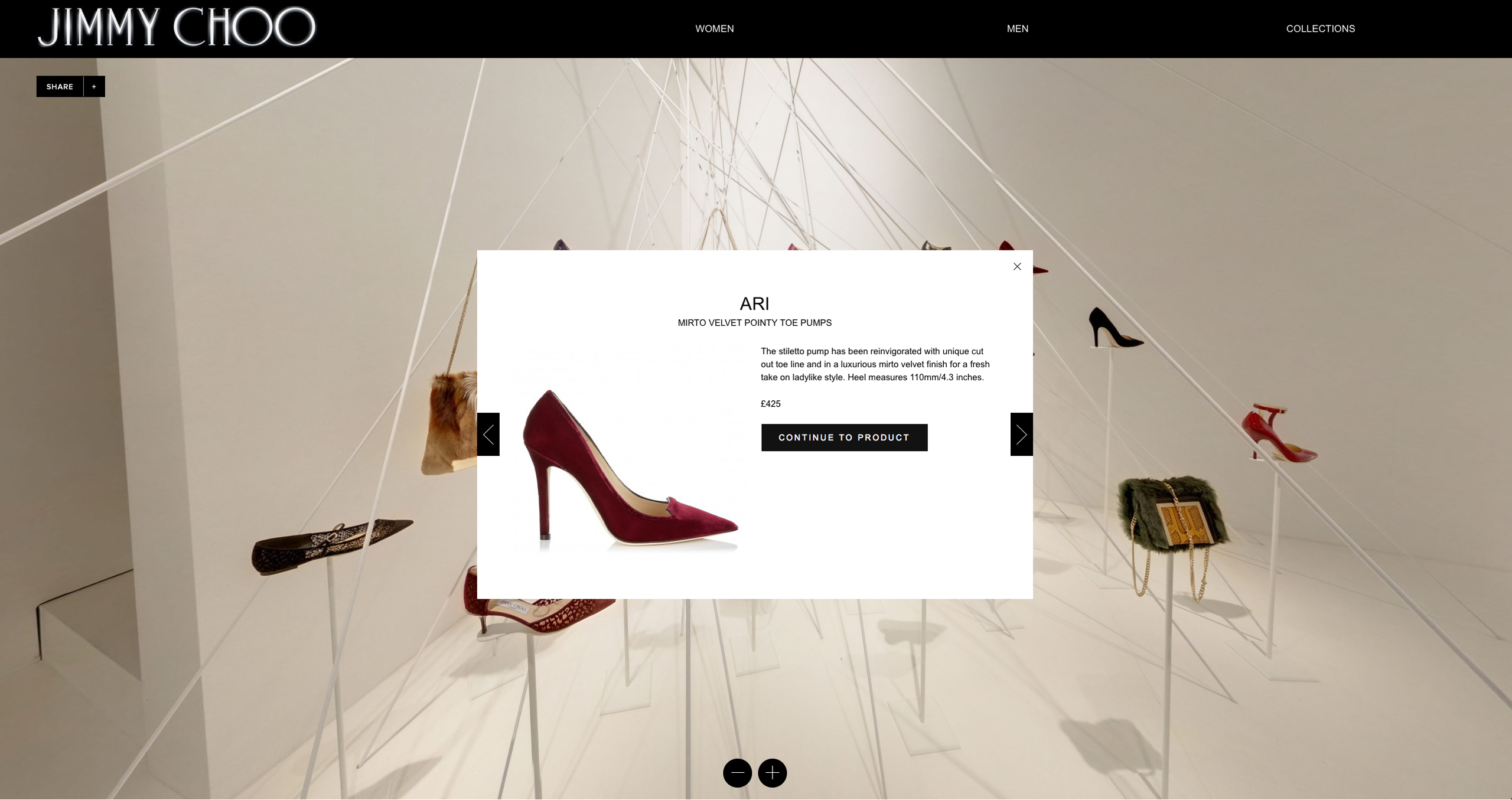
Jimmy Choo launched an online showroom for customers to browse and pre-order items from their newest collection before they hit shops. The technology was created by Avenue Imperial and some small London boutiques have already used the technology, but Jimmy Choo is the first major company to take it global. Buyers will be internet shopping as if in the store, and for some stores there will be an option to interact with a real shop assistant via instant message or video chat, making the experience even more realistic. Pros; if you don’t have time to go to the store you can get a similar experience online, in half the time it would take you physically getting to and back from the store. If a shop isn’t near by, or even in your country, you have access to the products and can get a similar experience to being in the shop from your laptop. Possibility of pre-ordering products before they are out, which is something you can rarely do when it comes to fashion, especially if there are a limited number of pieces available and they get snapped up quickly. The stores online display can be much more extravagant as it doesn’t have to be physically created. Cons; encourages customers to shop from their computers which could mean store seems less busy, staff hours / numbers may be cut. Customers are more likely to just buy the item they’re looking for, rather than seeing instore offers and buying more than they anticipated. Customers cannot try things on from a computer, perhaps meaning more returns and refunds for items that are purchased but do not fit. – Having looked at the online showroom, all the products seem to not be available online and you can’t have a close up look at them, which is a little pointless. It’s very much like google earth, you can click on spots and move to them, then look around with your mouse. The set up looks good, it’s a real studio with the items superimposed (I think?) but because of how you view it, things look a little distorted like on google earth, so I would say there are issues with how you are able to move around and the view you have. It’s an innovative idea but personally I’d prefer to visit the actual store.


Research; Wearable Tech

Wearable Tech
Solar panels on the shoulders of a suit jacket linked to a mobile phone changer?

Movement sensors that translate kinetic energy into power to charge your mobile phone. The more you move, the quicker it charges.

Research; 3D Printing

3D printing is a relatively new concept which isn't yet available to everyone, mainly because it's so expensive. Basically, it is making 3D objects from a digital file, e.g. CAD. the printer prints out the object layer by layer. The most common methods...

3D printed bowties and pocket squares:
Dita Von Teese in 3D Printed Dress
Made of nylon plastic
Can be intricate and detailed, not solid
Can be personalised, with a name perhaps?
No tying needed, fits onto top button (bowtie)
Pocket squares double up as business card holders
Numerous colours
No need to fold pocket square, wont crease

Dita Von Teese 3D printed dress
She wore first fully articulated, 3D printed dress
Designed by Michael Schmidt and Francis Bitonti
Printed with Shapeways
Nearly 3000 articulated joints
Over 13000 Swarovski crystals
Based on Fibonacci sequence
Made with Nylon
17 pieces, dyed black, laquered

Catherine Wales:
completed an MA in Digital Fashion at LCF
Catherine Wales; 3D Printed Feathers
sizes aren’t universal
not all size 8’s have the same body shape
she wants to offer personalised fashion that you can have made to your measurements
she creates accessory designs where you can input your measurements and print off to your size, so it fits perfectly

Noa Raviv:
Brings digital designs to life, not as a print but a 3D object
Reminds me of sea anemones
Structural, architectural

Research; Designers

Designers:
Unmade: knitted merino wool garments sporting patterns that you can adapt for yourself, so your garment is completely individual to you. Ranges of patterns that you can move the lines around / add splats or drips etc. Not H&M cheap but for quality wool printed with a unique pattern, great for the price. Jumpers around £200, scarves £60. Each garment is knitted on a loom to the exact design the customer chooses.

Marc Jacobs, SS12 ready to wear: laser cutting

Viktor & Rolf:
Spring 2016 Haute Couture inspired by Picasso, laser cut features attached to dresses making the models look like walk sculptures
Hussein Chalayan: Famous for making ‘showpieces’, not really wearable garments but more for the moment, watching a coffee table turn into a skirt for example. His SS07 collection was strange, with a sci-fi feel to some of the outfits when others looked like something you might see on the high street. He uses microchips and animatronics to make his dresses move. It’s really quite beautiful to see the fabric moving and completely changing the garments structure. Chalayan seems to like the contrast of soft fabrics against rigid ones as lots of his collections feature plastic looking dresses along with silks, an odd mix but it really shows the difference in the way the garments move.

Tailor Made London: They have a unique 3D body scanner to take measurements rather than taking them by hand. Much faster, more accurate, less intrusive to the customer. First and only English men’s tailors to use this state of the art tech. Customer only needs to attend a single consultation, cutting down time and allowing for completion times of just 4-6 weeks, considerably less than other tailors. Suits start at £660 and average at around £895, compared to Savile Row suits which start at £3,000 and average around £5,000, taking around 6 months to complete as opposed to 6 weeks.

Richard Nicoll: In partnership with Disney and Studio XO, he showcased a Tinkerbell inspired dress at his SS15 show during London Fashion Week. “It was imperative for Richard that what went down the catwalk was ‘fashion’ not ‘tech’. The gasps were audible as the dress appeared, it was a huge moment for fashion technology. We’d built something that was truly desireable.” Matthew Drinkwater, head of Fashion innovation Agency, who brought the collab together. The dress is made of fibre optic fabric activated by high intensity LEDs. This design sparked the idea that the wearable tech we’re creating doesn’t necessarily need to do anything, it could simply enhance the garment visually.

Mary Katrantzou: Uses digital printing on garments showing “an object from art or design that a woman would not be able to wear if it were real”. Her collections have been based on anything from perfume bottles to vintage postage stamps. She always keep the image is central to her aesthetic. “Each print is designed around the garment, and the garment simultaneously around the print.” “Digital print allows me to experiment with print in a way that fine art and other methods could not. It opens up a huge spectrum for possibility; I can create possibility out of impossibility, surrealism out of realism and both vice versa.”

Jonathon Saunders:
Peter Pilotto:
Alexander Wang:
Pharrell (Project Runway dress):
Alexander McQueen:
Gareth Pugh:
Bodi.me:
Laura Dempsey cargocollective:

Hermione de Paula: engineered printing (panelled printing), digital printing

Friday, 30 September 2016

Tailor Made London

-Rant Alert-
On Monday we had a talk from someone from Tailor Made London to help us with ideas about technology and tailoring coming together. I have been very sceptical about this company since I initially researched them for this term's work. They claim to be able to make bespoke suits for a fraction of the cost of Savile Row tailors, still keeping all the components of a fully bespoke suit. I find this very hard to believe as I know how much time and money goes into making a bespoke suit, I don't see how they can create something that costs £3000 on Savile Row and sell it for £660?
The first thing I noticed about the guy who came in to speak to us was that his suit didn't fit him that well, which was very surprising as he's the owner of a suit making company that is supposedly revolutionising the way we make suits. I also noticed the cuffs of his suit looked a bit strange, as if they didn't button up properly. Anyway he made a fairly good speech about their company and what they do using tech. Basically, they use a body scanner to measure the client, then there is a software that creates the pattern for the bespoke suit, then the fabric is laser cut to the pattern shapes. This then goes round their factory being put together and there is a fob on each garment which is scanned at each point so they can track each suit, which is clever. He also told us that they make their suits in Italy which was annoying because as a British company they are shipping their trade elsewhere to get it cheaper, when there are students like myself wanting jobs in that exact trade. When there was a chance for questions I asked (sounding a little angrier than I'd have liked to sound) about why the company was replacing the skills I am learning with machinery. He responded by saying that by using machinery rather than humans to measure, draft the patterns and cut out the fabric reduced the amount of human error and therefore each garment would be perfect. He said there would always be jobs putting the pieces together and hand stitching all the finishing touches for humans and that we would always need humans to run the machines. I didn't get a chance to respond as someone else asked a question, but this left me more annoyed, because there's also human error in sewing the pieces together and hand stitching! I'm sure it wouldn't be so difficult to invent robots or machines to do these jobs too in the near future, which would be cutting out the need for real people in these jobs at all! Besides, there can be human error in anything, for example a doctor diagnosing patients, are you going to replace them with a machine so they don't make any errors?
It worries me because what happens when these machines eventually break down and there isn't anyone left with the skills that the machines took over?
From a business point of view I can totally understand that it is a lot more cost effective to use machines rather than people but when you're passionate about something, you want the skill to live on and not die out.
Tailoring has been around for hundreds of years and processes haven't changed much because they haven't needed to. There isn't anything wrong with the way tailors work, and on a personal level I really enjoy pattern drafting, I don't want to be told I can't do it because it's much quicker and cheaper for a machine to do it for me. Unfortunately some people in my class don't enjoy that part of tailoring and would be very happy to let a machine do it for them.
I talked to one of our technicians after who completely agreed with me and didn't like that tech is taking over, which is totally different from the reactions I got from my other tutors who were all for the advancements in tech.
Having spoken to a few other students I found that some others felt like me too. I am concerned that I'm paying £9,000 a year for 3 years to be taught skills that are being replaced with tech literally as I'm learning them!
I'm all for using technology to assist design or manufacture, but when it removes skill and human ability then it's not an aid, it's a replacement which means we're slowly becoming less skilled. God forbid but we might actually end up like the film Wall-E predicted :(

That's enough of a rant, it would be interesting to see what others think, so if you've taken the time to read this then please drop me a comment saying whether you agree or disagree, and why. Do you study or work somewhere where tech is taking away your skills too? Let me know!
I'll leave this post with one saying:
"If it ain't broke, don't fix it."

Saturday, 24 September 2016

Research; Body Scanning

Body Scanning
Body scanning is a new technology that is starting to be used by tailors to take measurements. The traditional way, still used in Savile Row tailors, is to take the client into a curtained area and measure them over their clothes. The tailor takes an average of 25 measures which are written down and passed to the pattern cutter who draws the pattern based on the measurements. With the 3D body scanner, the client enters a fitting room equipped with 14 infared sensors. They should be wearing well fitting underwear so that the measurements can be taken accurately. In under 10 seconds, the sensors gather data from over 120 measurement points and measurements are accuarate to within 1/10 of a mm.
Pros:
- Quicker and more accurate than traditional measuring
- Pattern cutters can have a visual representation of the customer’s body and posture, rather than just the measurements and any notes taken by the measurer
- A client could potentially order a suit online taking measures with body scanner, never have to attend a fitting
- More private / less intrusive for customer as they aren’t being measured by a person
Cons:
- Removes the job of measuring and loses the skill
- Less of a personal experience for the client

Tailor Made London are the first and only English men's tailors to use a 3D body scanner to take measurements of their clients. The customer only needs to attend a single consultation where the measurements are taken and design elements and cloth are chosen. The suit is then made and the customer returns to collect the suit. If any alterations are needed they will be completed within an additional few days, but most men walk out with their suits straight away. The small number of visits the customer needs to part-take in reduces the time taken making the suit. Tailor Made London can make a suit within 4 to 6 weeks of the first consultation, as opposed to traditional Savile Row suits taking up to 6 months, with multiple fittings required. The cut down on time also considerably reduces cost, with a Tailor Made London suit starting at £660 and averaging around £895, compared to Savile Row prices starting around £3,000 and averaging about £5,000.

Tailor Made London have access to the same fabrics as Savile Row tailors and claim their suits are made to the same standard, however I'm sceptical because I cannot see how the price can possibly be reduced by that much. I feel that there must be some reduction of hand sewing, either that or the labour is shipped elsewhere for lower costs. They're visiting us on Monday at uni so they may convince me otherwise then.

Second year; First term; Technology in Tailoring

First term of second year starts on Monday, our project is Technology in Tailoring, and I've been given some things to research in order to choose which way I want to take my work. At first I was really negative about this project, I won't lie, because all I had in my head was tacky lights on a suit, like something Will.I.Am would wear...

This isn't really something I wanted to make, and I hadn't thought about any other kind of technology that I could use. But I've done my research and now I'm actually kinda excited! There's lots of tech I could use if I wanted, and most of it we have access to at uni.

I don't have an actual brief yet but I will upload it when I get one.

I'm breaking my research down into a few posts because there's a lot of it!